If you are new to Pagan spirituality, it does not take long before three words begin appearing everywhere: Paganism, Wicca, and witchcraft. Sometimes they are used as though they mean exactly the same thing. Elsewhere, people insist that they are completely separate. One book may describe Wiccans as witches, another may talk about Pagan witches who are not Wiccan, and a third may introduce forms of Paganism that have very little to do with witchcraft at all.
The confusion is understandable because these worlds do overlap. They share communities, history, language, symbols, seasonal celebrations, and sometimes practices. But they are not three different names for one spiritual path.
The simplest way to understand the relationship is this: Paganism is a broad religious and spiritual landscape, Wicca is one particular religion within that landscape, and witchcraft is a form of practice that may or may not be connected to either of them.
That distinction becomes much easier to understand once we stop treating spiritual identity as a set of boxes and look instead at what each term is actually describing.
What Is Paganism?
Modern Paganism is an umbrella term covering a diverse group of contemporary religious and spiritual traditions. Many of these traditions draw inspiration from pre-Christian religions, mythology, folklore, seasonal cycles, nature, and different forms of polytheism or animism.
There is no single Pagan church, authority, creed, or sacred text that defines what every Pagan must believe. Someone might follow Wicca, Druidry, Heathenry, Hellenic polytheism, Roman reconstructionism, or another established tradition. Another person may practise more individually, combining nature spirituality, seasonal observance, ancestor work, devotional practice, or ritual without belonging to one organised path.
This variety is one reason Paganism can be difficult to explain in a single sentence. It describes a broad religious family rather than one uniform religion. Many Pagans feel a strong spiritual relationship with nature and the changing seasons, but even that relationship can be understood differently. For one person, the natural world may be sacred in itself. For another, nature may be a place through which they experience particular gods or spirits. Someone else may approach seasonal practice primarily through ritual, mythology, or a sense of belonging to the landscape where they live.
What matters here is that being Pagan does not automatically mean being Wiccan, and it does not automatically mean practising witchcraft. A Pagan may practise magic regularly, occasionally, or not at all.
What Is Wicca?
Wicca is a modern Pagan religion that emerged publicly in Britain during the twentieth century and became one of the best-known forms of contemporary Paganism.
Because Wicca became so visible in books, popular culture, and later online spirituality, many people first encounter Paganism through Wiccan concepts. This has sometimes created the impression that Paganism and Wicca are interchangeable, but Wicca is only one part of the much larger Pagan landscape.
Different Wiccan traditions vary, but Wiccan practice commonly places importance on ritual, nature, seasonal cycles, and sacred relationship with the divine. Many Wiccans celebrate a cycle of eight seasonal festivals often called the Wheel of the Year, as well as lunar rites. Magic or witchcraft is also an important part of many forms of Wicca.
Historically, traditional forms of Wicca developed as initiatory religions organised through covens, although solitary forms of Wiccan practice have become widespread as well. Modern practitioners may therefore encounter quite different versions of what it means to be Wiccan depending on the tradition, teacher, book, or community they meet.
The important distinction for a beginner is that Wicca is a religion, not simply another word for all Paganism and not a label that automatically applies to everyone who practises witchcraft.
What Is Witchcraft?
Witchcraft is the term that becomes most complicated because different cultures, historical periods, and practitioners have used the word in very different ways.
In contemporary spiritual communities, witchcraft usually describes a form or collection of practices rather than one single religion. Those practices may include ritual, spellwork, divination, herbal traditions, charms, symbolic work, meditation, folk practices, work with spirits, or other methods of directing intention and interacting with the sacred or magical world.
The exact meaning depends heavily on the practitioner and the tradition. For some people, witchcraft is inseparable from their religion, and a Wiccan, for example, may understand witchcraft as part of their religious practice. For someone else, witchcraft may be spiritual without being connected to a specific religion at all. Another person may practise witchcraft while belonging to a different religious tradition or while identifying as agnostic or non-religious.
This is why the statement that all witches are Pagan is not accurate. Some are, and some are not. In the same way, practising witchcraft does not automatically make someone Wiccan.
So What Is the Difference Between Paganism, Wicca, and Witchcraft?
It helps to think about what kind of thing each word is describing.
Paganism describes a broad religious and spiritual family. Within that family are many different religions and paths.
Wicca describes one particular modern Pagan religion. It has its own history, traditions, ritual forms, and theological ideas.
Witchcraft describes a practice or group of practices. It can exist within Wicca, within other Pagan traditions, or outside Pagan religion altogether.
The boundaries are not always perfectly clean because real people rarely build their spiritual lives according to dictionary diagrams. A person might describe themselves as Pagan and a witch but not Wiccan. Another might be Wiccan and naturally use both the words Wiccan and witch. A third might be Pagan but have no interest in witchcraft whatsoever.
All three positions can make complete sense once you understand that these words are describing different layers of identity, religion, and practice.
Are All Wiccans Witches?
This question has a slightly more complicated answer than it first appears to. Wicca has historically been closely connected with modern religious witchcraft, and many Wiccans identify comfortably as witches. In some traditional Wiccan contexts, the relationship between the two terms is particularly strong.
However, language changes, communities differ, and individuals choose their own identities. Not every person who describes themselves as Wiccan necessarily emphasises the word witch in the same way.
For a beginner, it is more useful to understand the historical and practical connection between Wicca and witchcraft than to try to enforce one universal label on every Wiccan practitioner.
Are All Witches Pagan?
No. This is one of the most common misunderstandings surrounding modern witchcraft.
Some witches are Pagan. They may practise within Wicca or another Pagan tradition, or they may simply describe their spirituality as Pagan while maintaining an individual form of witchcraft. Other witches do not consider themselves Pagan at all.
Because witchcraft describes practice rather than membership in one universal religion, it can appear in very different spiritual contexts. The beliefs surrounding those practices can therefore differ dramatically. Two people may both use the word witch and still disagree about gods, spirits, magic, ritual, ethics, the afterlife, or almost every other theological question.
The shared label tells you something about their practice, but it does not tell you everything about their worldview.
Can You Be Pagan Without Practising Witchcraft?
Absolutely. You can follow a Pagan religion, honour gods, observe seasonal festivals, work with ancestors, pray, make offerings, study mythology, practise meditation, or develop a deep spiritual relationship with the natural world without ever performing a spell.
For some Pagan traditions, magic may play an important role. For others it may be secondary, optional, understood differently, or largely absent from an individual practitioner’s spiritual life.
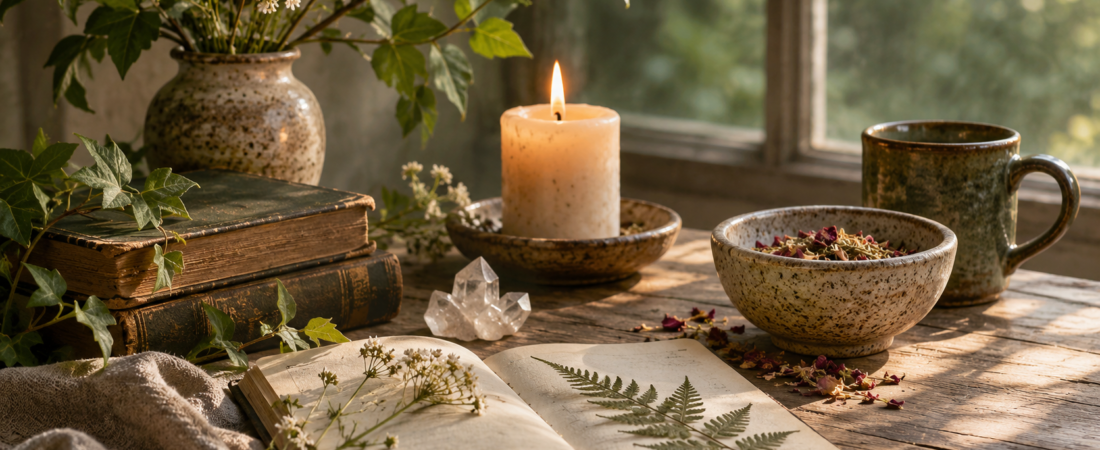
This distinction matters because popular culture often collapses Pagan spirituality into witchcraft aesthetics. Candles, crystals, tarot cards, spell jars, and dramatic altars are visually easy to recognise, so they often become shorthand for Paganism online. But a religion cannot be reduced to its most photographable objects.
Pagan spirituality may be expressed through theology, devotion, ethics, ritual, community, history, environmental relationship, ancestor traditions, seasonal practice, and many other aspects of life that do not necessarily look dramatic on social media.
Can You Practise Witchcraft Without Being Wiccan?
Yes, and many modern witches do exactly that.
A witch may work within folk magic, traditional witchcraft, an eclectic personal practice, another Pagan religion, or no formal religious structure at all. This distinction is especially useful for beginners because many introductory books written during earlier waves of modern witchcraft publishing were heavily influenced by Wicca. As a result, practices associated with Wicca were sometimes presented as though they were universal rules of witchcraft.
They are not.
Ideas about ritual circles, elements, deities, magical tools, ethics, seasonal festivals, and magical correspondences can vary enormously between traditions. Learning where a practice comes from is therefore often more useful than simply collecting practices because they have been labelled “witchy.”
What About Nature Spirituality?
Nature spirituality overlaps strongly with modern Paganism, but it is another term that should not automatically be treated as identical to Paganism, Wicca, or witchcraft.
A person may experience the natural world as spiritually meaningful without identifying as Pagan. Someone may follow seasonal cycles, practise ecological spirituality, or develop rituals around place without adopting any particular religious label.
Within Paganism, however, the natural world often becomes an important part of spiritual practice. The seasons, Moon, Sun, plants, animals, weather, landscape, and cycles of birth, growth, death, and renewal can provide both practical rhythms and spiritual symbolism.
This is one reason nature spirituality can be such a useful starting point for people who are curious about Paganism but are not yet certain what they believe. It allows practice to begin with observation and relationship rather than forcing a person to choose a complete religious identity before they have had time to explore.
Do Pagans Worship Nature?
Some do, although the phrase can be misleading because it compresses many different beliefs into one idea.
For some Pagans, the natural world itself is sacred. For others, nature is inhabited by spirits or expresses divine presence. Polytheistic Pagans may worship particular gods while also maintaining strong spiritual relationships with land and seasonal cycles. Others may describe their spirituality as earth-centred without literally worshipping trees, rivers, or the Moon.
There is therefore no single Pagan answer to this question. If you are exploring Paganism, it is usually more useful to ask how a particular tradition understands the relationship between humanity, nature, and the sacred than to assume every Pagan shares the same theology.
What About the Wheel of the Year?
The Wheel of the Year is another reason Wicca, Paganism, and witchcraft are often blurred together.
The familiar modern Wheel of the Year consists of eight seasonal festivals spread throughout the annual cycle. It became strongly associated with Wicca and modern Druidry and has since been adopted or adapted by many other Pagan practitioners.
Today, you will find Pagans who celebrate all eight festivals, people who observe only some of them, and practitioners whose religious calendars come from entirely different historical traditions. A witch may also celebrate the Wheel of the Year without being Wiccan.
Shared practice does not necessarily mean shared identity.
For beginners, the Wheel of the Year can still be a beautiful way to begin noticing seasonal change. The important thing is to understand it as one modern Pagan framework rather than a universal calendar that every Pagan throughout history followed.
Which Path Is Right for You?
If you are asking whether you are Pagan, Wiccan, or a witch, you may feel as though you need to choose the correct answer immediately. In reality, you can give yourself time to explore before deciding whether any particular label belongs to you.
Labels can be useful because they give us language, history, community, and ways to find people who share similar practices. They become less useful when we treat them as a test we have to pass before we are allowed to begin.
Instead of asking only, “What should I call myself?”, it may help to ask:
- Are you looking for a religion, or mainly for a spiritual practice?
- Are you interested in particular gods or devotional traditions?
- Does ritual appeal to you?
- Are you drawn to magical practice?
- Do you want to understand seasonal or lunar cycles more deeply?
- Are you interested in mythology, ancestors, nature, home, or everyday spiritual practice?
- Do you want to follow an established tradition, or are you still exploring?
Your answers may change as you learn more, and that is not a problem. You can study Wicca without deciding that you are Wiccan. You can learn about witchcraft without deciding that you are a witch. You can explore Pagan spirituality for months or years before finding a more specific word that feels useful.
A spiritual identity is often more meaningful when it grows out of practice rather than being chosen before the practice exists.
Where Should a Beginner Start?
If all these distinctions still feel overwhelming, begin by learning slowly and paying attention to context. Read about the traditions that interest you, but do not try to absorb the entire Pagan internet at once. Notice where information comes from and whether a particular practice belongs to Wicca, another Pagan religion, a folk tradition, modern witchcraft, ceremonial magic, or simply one author’s personal system.
At the same time, begin developing a practice that does not require certainty. Spend time outside deliberately, observe the Moon for a month, notice the changing season where you actually live, keep a journal, read a myth slowly instead of collecting twenty summaries of it, or try a simple grounding practice. Small experiences give abstract ideas somewhere to become real.
The goal is not to assemble the correct aesthetic or collect enough spiritual vocabulary to sound knowledgeable. It is to discover what creates genuine meaning, attention, relationship, and responsibility in your own life.
Pagan, Wiccan, or Witch: You Do Not Have to Decide Today
The distinction between Paganism, Wicca, and witchcraft matters because these words have histories, communities, and traditions behind them. Understanding the difference helps you approach those traditions more accurately and makes the wider spiritual landscape much easier to navigate.
At the same time, understanding the terminology does not mean you have to select a label immediately. Paganism offers a broad landscape of contemporary spiritual and religious paths. Wicca is one particular religion within that landscape, while witchcraft describes forms of practice that can overlap with both and can also exist independently of them.
Once that relationship becomes clear, the pressure to find the perfect label usually begins to ease. You can turn your attention toward the more useful question of what actually draws you to this subject in the first place. It may be nature, ritual, the Moon, mythology, old gods, seasonal change, magic, ancestry, or simply the feeling that there may be another way of relating to the world around you.
Whatever the starting point is, allow yourself to explore it before trying to define the entire path. A spiritual identity can emerge gradually from what you learn, what you practise, and what continues to feel meaningful over time. You do not have to name everything at the beginning in order for the beginning to matter.
Where to Go Next
If this is your first step into Pagan spirituality, a useful next read is What Is Modern Paganism? A Beginner’s Guide to Beliefs, Practice, and Finding Your Path. That guide looks at the wider Pagan landscape, common beliefs and practices, and simple ways to begin without feeling pressured to choose a specific tradition immediately.
If you would rather learn through experience than spend another week opening browser tabs, the 7-Day Modern Pagan Practice Starter Kit offers a short introduction to attention, grounding, place, intention, and simple ritual. It is designed for beginners who want to explore what practice actually feels like before deciding how they want to describe themselves.
For a more structured introduction, Modern Paganism: A 30-Day Practical Guide to Nature Spirituality, Simple Rituals, Moon Magic, and the Wheel of the Year develops those ideas over a full month. The focus is not on handing you a ready-made identity, but on helping you build enough knowledge and practical experience to understand what genuinely fits into your own life.
You do not need to leave this article knowing whether you are Pagan, Wiccan, a witch, none of those things, or something you have not discovered yet. At this stage, understanding the landscape is enough. From there, practice, curiosity, and time can do the rest.